
WISHES: very good lesson plan on wishes (by Cristina Cabal)
EXPLANATION WITH GOOGLDE SLIDES AND VIDEOS (good slide explanation)
EXERCISES
Choose the correct options to complete the text.
WISHES: very good lesson plan on wishes (by Cristina Cabal)
EXPLANATION WITH GOOGLDE SLIDES AND VIDEOS (good slide explanation)
EXERCISES
Choose the correct options to complete the text.

This type of mixed conditional refers to an unreal past condition and its probable result in the present. These sentences express a situation which is contrary to reality both in the past and in the present. In these mixed conditional sentences, the time is the past in the "if" clause and in the present in the main clause.
If I had studied I would have my driving license.
(but I didn't study and now I don't have my license)
These mixed conditional sentences can also refer to an unreal present situation and its probable (but unreal) past result.
If I was a good cook, I'd have invited them to lunch.
Present: I'm not a good cook
Past: I would probably not have invited them to lunch
EXERCISES
Mixed conditional practice (multiple choice after the explanation)
All conditionals – mixed conditionals, alternatives to if, inversion
 |


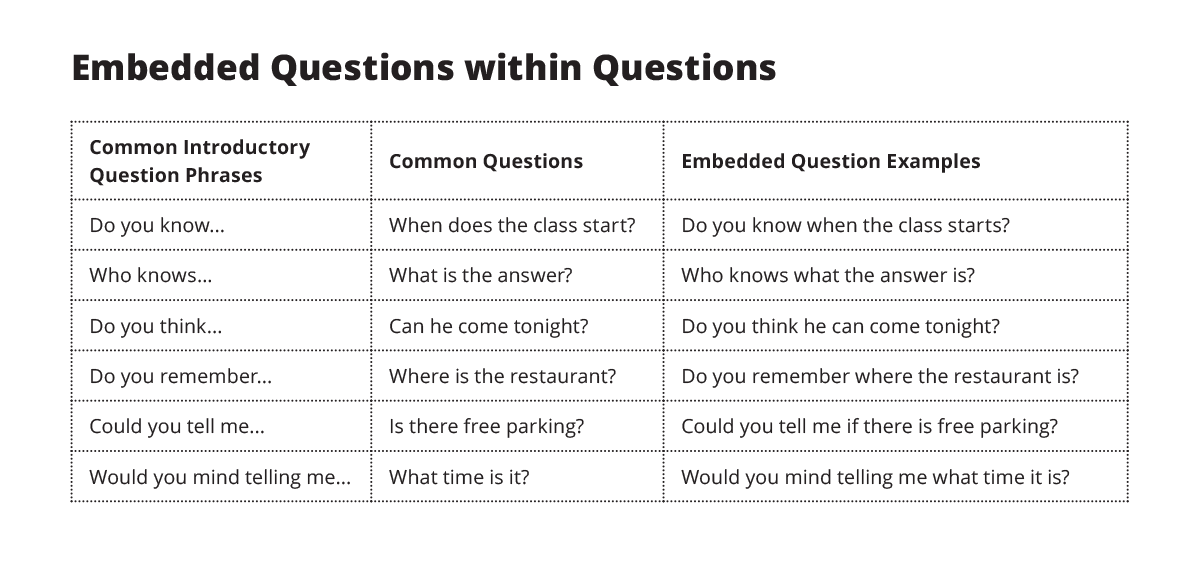
Explanation of the University of Victoria + exercise (at the bottom of the page)
Explanation by Langeek
EXERCISE: Perfec English Grammar (embedded questions)
EXERCISE: LIVE WORKSHEETS

Indirect questions explanation (English)
Indirect questions explanation (Spanish)
EXERCISE: Perfec English Grammar (reported questions)
Explanation 2 with exercises (The British Council)
engexam: How to write a review? | C1 Advanced (CAE)

A thesis statement is the main idea of an essay. It consists of the topic of the essay and the writer's claim about the topic that will be proven throughout the essay. The thesis usually appears at the end of the introduction, often as the last sentence, and lets the reader know what to expect.
Your objective is to give the reader a dominant impression of an experience or some aspect of your personality. In writing your thesis statement, use descriptive language rather than vague words such as: interesting, unusual, important, and great.
In conversation, you often begin a story by saying, “The weirdest thing happened to me the other day” or “I saw something amazing last week at the zoo” “I had a frightening experience in the elevator at work once” or “Men are strange, ya know? Like, one time….”


WORDS ENDING IN -A: media, data, bacteria
INDEFINITE PRONOUNS: everybody, everyone...

WORDS ENDING IN "-S": news, series...

FAMILY IS or FAMILY ARE? POLICE is or POLICE ARE?

GENERAL STATEMENTS
The absence of a determiner before plural countable nouns
Specific vs General statements


